.png)

Digital transformation rarely fails because an organization has run out of ideas. More often, the difficulty lies in turning those ideas into changes that people can adopt, teams can sustain, and the business can actually measure.
A company may have invested in new systems, identified opportunities for automation, or developed an ambitious digital roadmap. Yet progress can still feel slower than expected. Different functions may have competing priorities, technology decisions may be disconnected from business needs, and the people responsible for delivery may already be managing demanding operational responsibilities.
This is where a fractional Chief Digital Transformation Officer (CDTO) can offer a different approach. Rather than treating digital transformation as a collection of technology projects, the role brings senior leadership attention to the business changes those projects are intended to create.
A roadmap can describe what an organization wants to implement. It does not, by itself, resolve who will make the decisions, how competing priorities will be managed, or what needs to change in day-to-day operations.
Consider a business introducing a new customer relationship management system. The technology may be ready, but sales teams may still work through familiar spreadsheets, reporting definitions may differ across departments, and managers may not yet see how the new system improves their decisions.
The challenge is no longer simply implementation. It is aligning processes, people, and accountability around a better way of working. A fractional CDTO can help bridge that gap by connecting digital initiatives to commercial and operational outcomes.

The fractional model gives an organization access to experienced transformation leadership for an agreed scope and level of engagement, rather than requiring an immediate full-time executive appointment. Its advantage is not simply flexibility, but the ability to bring focused leadership to a problem that may otherwise remain spread across several functions.
A fractional Digital Transformation Officer can help distinguish between initiatives that are important and those that are merely underway. By connecting digital priorities to business needs, the organization can concentrate its attention and resources on changes that are likely to make a meaningful difference.
Transformation often slows when decisions sit between departments or ownership is unclear. A fractional leader can help establish who is responsible for key decisions, how issues should be escalated, and what needs to happen next.
A digital ambition becomes more useful when it is translated into a practical sequence of actions. The role can help connect long-term objectives with immediate priorities, realistic milestones, and clear measures of progress.
The objective is not to create permanent dependence on an external leader. Effective fractional digital transformation leadership also helps internal teams develop the ownership, processes and capabilities needed to sustain change.
The strongest transformation agendas begin with a clear understanding of the business. For one organization, the priority may be improving customer experience. For another, it may reduce manual work, creating better visibility across operations, or strengthening digital sales channels.
Before recommending new solutions, a fractional CDTO can review existing systems, processes, and on-going initiatives. This helps identify what is already working, where duplication exists, and which constraints are genuinely affecting performance.
The objective is not to digitize everything. It is to identify where digital change can address a meaningful commercial or operational need, whetherthat involves improving service, reducing inefficiency, or enabling better decisions.
Not every initiative needs to happen at once. A practical digital transformation strategy establishes what should come first, which activities depend on one another and where the organization has the capacity to deliver change effectively.
For example, a growing distribution business may initially believe it needs a major technology overhaul. A closer review may reveal that the more immediate issue is inconsistent with customer and inventory information across teams. Establishing common data definitions, improving system usage and clarifying ownership may create more value in the near term than introducing another platform.
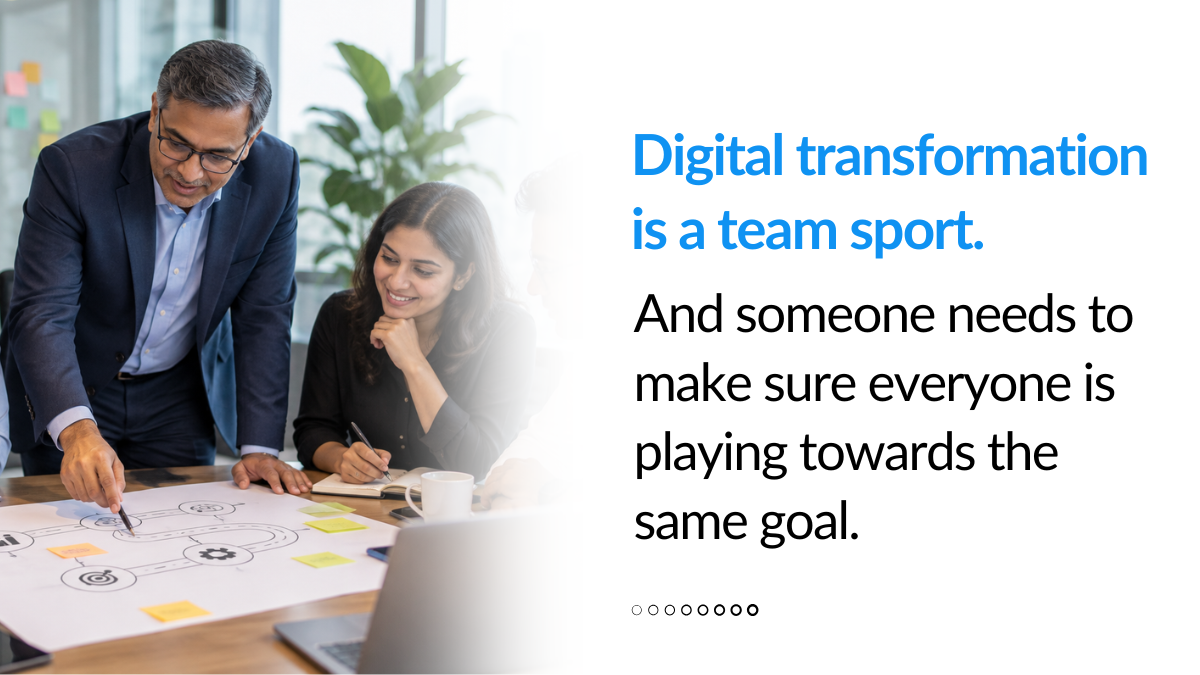
Digital transformation is rarely owned by one department alone.Technology may enable the change, but its success often depends on sales,operations, finance, human resources, and other functions working together.
A fractional CDTO can help ensure that different functions are working toward the same business outcome. This reduces the risk of individual departments improving their own processes while the wider customer or operational experience remains fragmented.
Transformation becomes easier to manage when teams understand who owns implementation, who makes decisions, and who is responsible for the outcome. Clear accountability also helps prevent important activities from falling between functions.
For instance, improving the customer journey may require changes in how sales captures information, how operations fulfil commitments, and how finance tracks performance. The transformation leader’s contribution is to keep these connected rather than treating them as separate departmental projects.
Speed in transformation should not be confused with rushing implementation. Moving quickly into the wrong solution can create additional cost, complexity, and resistance. A more useful approach is to establish clear priorities and build momentum through visible progress.
A fractional CDTO may begin by examining the existing portfolio of initiatives. Some projects may need to be accelerated, others simplified, and some may need to stop altogether if they no longer serve the business.
Progress can often be improved by addressing decisions that have remained unresolved. Bringing the right stakeholders together and clarifying the next steps can help teams move forward without necessarily introducing more technology.
Early improvements can build confidence when teams see that a change reduces repetitive work, improves information, or makes a process easier. These results make the broader transformation more tangible and encourage adoption.
Lasting change requires more than an initial improvement. A good transformation leader also works to establish internal ownership, appropriate capabilities,and a way to sustain progress after the fractional engagement evolves or concludes.

The model is particularly useful when an organization needs senior transformation expertise but does not yet require or is not ready to commit to a full-time executive role.
A growing business may need more scalable processes, better information, and stronger coordination across functions. A fractional CDTO can help establish the transformation priorities that support that next stage.
An organization may already have several digital initiatives underway but lack a clear view of how they connect. Fractional leadership can help reassess priorities, resolve dependencies, and restore a more focused approach to delivery.
Some businesses may want to understand their long-term transformation needs before making a permanent executive appointment. A fractional engagement can help clarify the mandate, establish initial priorities, and inform the leadership structure required.
The important question is not whether fractional leadership is inherently better than a permanent appointment. It is whether the organization has a clear enough mandate, appropriate executive sponsorship, and the willingness to act on the decisions required.
Digital transformation is often described in terms of technology, but its pace is shaped just as much by leadership, coordination, and the ability to make decisions.
A fractional Chief Digital Transformation Officer can help an organization bring these elements together: setting priorities, connecting functions, guiding execution and building the capabilities needed for change to continue.
The result is not necessarily a bigger transformation programme. Often,it is a more focused one.
And when an organization becomes clearer about what needs to change, who owns it and how progress will be measured, digital change has a much better chance of moving from ambition to meaningful business impact.
Looking to bring greater focus and momentum to your digitaltransformation? COHIIRE connects businesses with experienced fractional CXO leadership to help address critical business priorities.
.png)