
.png)

.png)
Every growing business reaches a point where financial management becomes more complex. Cash flow needs closer attention, expansion plans require financial modelling, investors expect greater visibility, and leadership teams need stronger financial insights to make informed decisions.
At this stage, having the right financial leadership becomes essential.
But does every business need a full-time Chief Financial Officer? Not necessarily.
For many organizations, the decision comes down to choosing between a Fractional CFO and a Full-Time CFO. Both bring strategic financial expertise, but the right choice depends on the company's size, growth stage, financial complexity and long-term priorities.
Understanding the differences can help businesses access the financial leadership they need without committing to a structure that may not yet be necessary.
A Fractional CFO is an experienced finance leader who works with a business on a part-time, flexible or contractual basis rather than as a permanent, full-time executive.
Unlike a traditional accounting or book keeping professional, a Fractional CFO focuses on strategic financial leadership, helping organizations make informed decisions about growth, profitability, investments and financial risk.
Depending on the organization's requirements, Fractional CFO services may include:
· Financial Planning and Analysis (FP&A): Developing budgets, forecasts and financial models to support business decisions.
· Cash Flow Management: Improving cash visibility, working capital management and liquidity planning.
· Fund raising Support: Preparing financial information, investor presentations and financial projections.
· Financial Strategy: Advising leadership on profitability, pricing, capital allocation and expansion opportunities.
The scope of engagement can evolve with the business, allowing organizations to access senior financial expertise based on their current priorities.
A Full-Time CFO is a permanent member of the senior leadership team responsible for overseeing the organization's financial strategy, financial operations, governance and long-term financial performance.
In larger or more complex organizations, the CFO often plays a central role in shaping business strategy alongside the CEO and Board.
· Long-term financial strategy and capital allocation
· Financial reporting, compliance and governance
· Investor, lender and Board relationships
· Enterprise-wide financial planning and risk management
· Mergers, acquisitions and business restructuring
· Finance team leadership, capability building and succession planning
The choice between a Fractional CFO vs Full-Time CFO is not simply about cost. It is about the level of financial leadership, involvement and organizational integration a business requires.
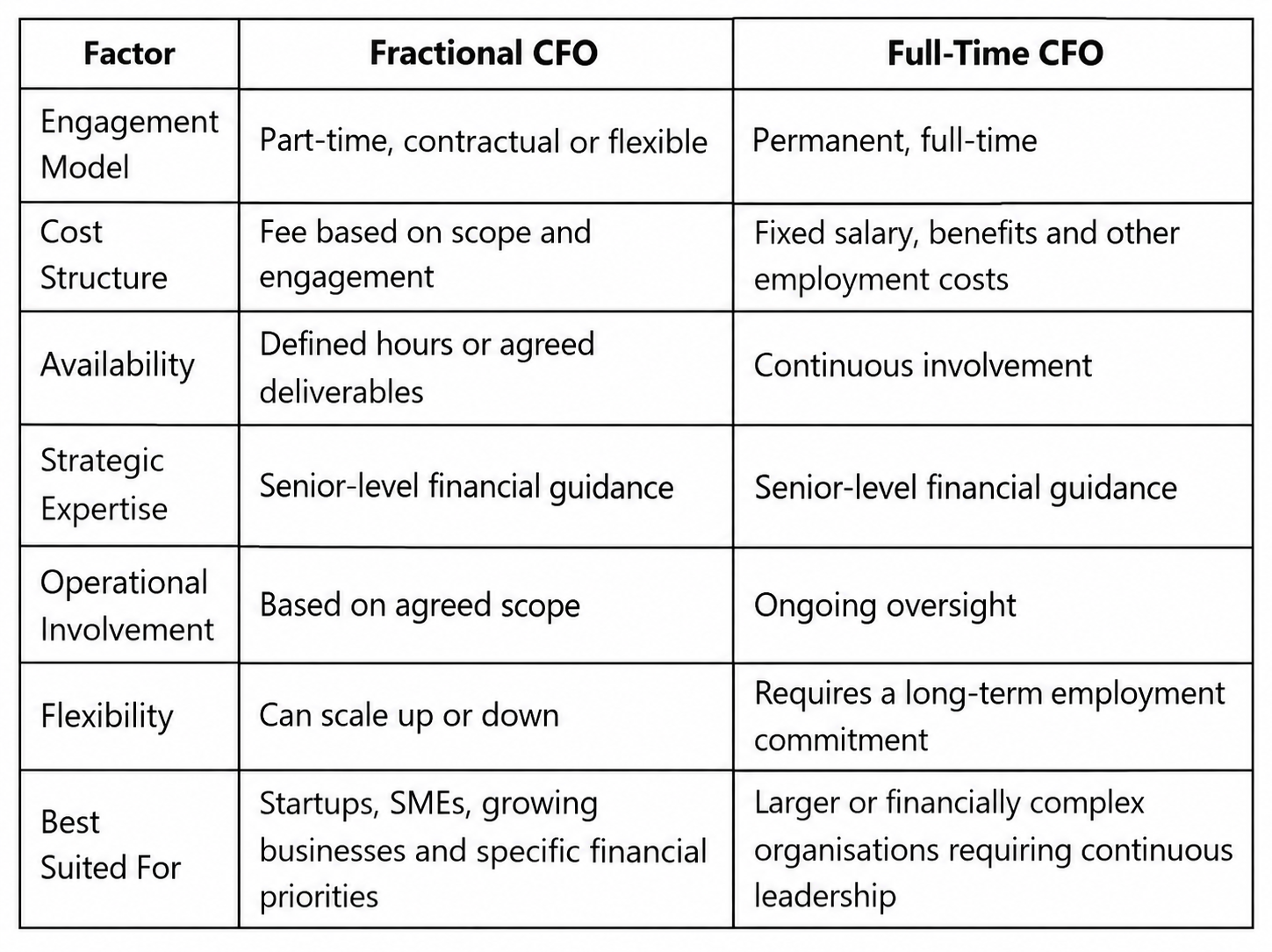
For businesses that need experienced financial leadership but do not require a permanent CFO, the fractional model offers several advantages.
A Fractional CFO can bring experience gained across multiple organizations, industries and business situations.
This exposure can be particularly valuable for founders navigating financial challenges for the first time, whether related to fundraising, expansion, profitability or restructuring.
One of the primary Benefits of a Fractional CFO is the ability to access senior-level expertise without the fixed employment costs associated with a permanent executive.
Businesses can structure engagements around specific priorities, projects or recurring financial leadership requirements.
A company's financial requirements are rarely static.
A business may initially need support with budgeting and cash flow forecasting, followed by more intensive involvement during fundraising, acquisitions or geographical expansion.
Fractional engagements can be adjusted as these requirements evolve.
An experienced Fractional CFO can bring an independent perspective to existing financial processes, business assumptions and growth plans.
This can help leadership teams identify risks, challenge financial assumptions and evaluate opportunities more objectively.
Fractional CFOs can also provide financial leadership during periods of transition, including:
· Rapid business expansion
· Fundraising or investor discussions
· Financial restructuring
· Mergers and acquisitions
· Finance transformation initiatives
· Preparation for a permanent CFO appointment

The right financial leadership model often depends on where the business is in its growth journey.
At an early stage, founders often manage financial decisions themselves, supported by accountants or external financial advisers.
However, as operations expand, businesses need greater clarity on cash flow, funding requirements and financial performance.
A Fractional CFO can help establish:
· Financial planning and budgeting processes
· Cash flow forecasts and runway visibility
· Unit economics and profitability metrics
· Investor-ready financial reporting
· Financial controls and decision-making frameworks
As businesses scale, financial decisions become more interconnected.
Expansion may involve new markets, larger teams, additional financing requirements and more complex working capital cycles.
At this stage, a Fractional CFO can support:
· Profitability improvement initiatives
· Working capital optimization
· Financial forecasting and scenario planning
· Banking and funding discussions
· Performance reporting and financial controls
High-growth organizations often face more demanding financial requirements.
Whether the business is preparing for a funding round, entering new markets or evaluating acquisitions, financial decisions can have significant long-term consequences.
A Fractional CFO may help with:
· Fundraising preparation and investor engagement
· Capital allocation and investment evaluation
· Financial due diligence
· Expansion planning and financial modelling
· Strengthening governance and reporting systems
However, as financial complexity increases, the business may require more consistent executive involvement.
Larger organizations typically require financial leadership that is deeply integrated into business strategy, operations and governance.
Multiple business units, complex regulatory requirements, significant capital commitments and extensive stakeholder relationships often demand continuous CFO involvement.
While Fractional CFO Services offer flexibility, there are situations where a permanent CFO becomes more appropriate.
· Increasing Financial Complexity: Multiple entities, business units or geographies require continuous financial oversight.
· Frequent Strategic Decisions: Major investments, financing arrangements or acquisitions demand ongoing executive involvement.
· Greater Governance Requirements: The organization faces extensive reporting, compliance or stakeholder expectations.
· Large Finance Teams: The finance function requires a dedicated executive to build capabilities and drive performance.
· Long-Term Transformation: The organization needs sustained financial leadership across multiple strategic initiatives.
The transition from fractional to full-time financial leadership should be driven by business requirements rather than company size alone.
Before making the decision, leadership teams should evaluate their financial requirements across four areas.
Does the business primarily need strategic guidance on specific financial priorities, or does it require continuous oversight of complex financial operations?
Can the organization benefit from a CFO working on agreed priorities each week, or is daily executive involvement essential?
A strong finance team may already handle accounting, reporting and compliance effectively.
In such cases, a Fractional CFO can complement the existing team by providing strategic direction and senior-level oversight.
The decision should account for both current requirements and future business priorities.
A company preparing for significant expansion, institutional investment or organizational transformation may need a different financial leadership structure within the next 12–24 months.
The objective is to select a model that supports the business today while remaining aligned with its future direction.

Yes. For some organizations, fractional financial leadership can serve as a bridge towards establishing a permanent CFO position.
A Fractional CFO may initially help the business strengthen its financial processes, improve reporting, establish governance frameworks and define the responsibilities of a future finance leader.
As the organization grows, it can evaluate whether the existing fractional arrangement remains sufficient or whether a permanent CFO appointment is required.
This approach allows businesses to build financial leadership capabilities progressively, rather than committing to a permanent structure before the need is fully established.
Choosing between a Fractional CFO and a Full-Time CFO is ultimately about aligning financial leadership with the organization's stage, complexity and strategic priorities.
Neither model is inherently better. The right choice is the one that delivers the level of financial leadership the business needs.
At COHIIRE,we believe businesses should be able to access experienced leadership withoutany delay.
.png)