
.png)

.png)
Business transformation is rarely just about a new strategy, structure, system, or process. It is about how people respond to change, how leaders stay aligned, how culture adapts, and how the organization builds the capability to work differently.
Many companies begin transformation with a strong business case. They may be entering a new market, preparing for scale, integrating after a merger, digitizing operations, restructuring teams, or improving performance. On paper, the plan may look clear. But once the transformation moves into execution, the real complexity often appears inside the organization.
Teams may resist change. Decision-making may slow down. Leaders may interpret priorities differently. Old ways of working may continue even after new structures are introduced. This is why companies increasingly look at a Fractional Chief OD Officer during critical phases of business transformation.
A Fractional Chief OD Officer brings senior organizational development leadership without the company having to create a full-time role immediately. For businesses going through change, this can provide the structure, objectivity, and people-focused direction needed to make transformation work in practice, not just in planning.

Most transformation plans focus heavily on systems, numbers, reporting lines, processes, and outcomes. These are important. But transformation does not succeed only because a new model is designed. It succeeds when people understand it, trust it, and are able to work within it.
Harvard Business School describes organizational transformation as a process of realigning structure, culture, and operations to adapt to internal or external change. That means people, culture, and operating rhythm are not side issues. They are central to whether transformation succeeds. (Harvard Business School)
This is where organizational development leadership becomes important.
A company may know what it wants to change but may not have the internal capability to manage the human side of that change. For example, a leadership team may agree that the business needs more agility, but middle management may still be working through old approval systems. A company may want stronger accountability, but its performance systems may not support it. A founder may want scale, but decision-making may still be too founder dependent.
A Fractional Chief OD Officer helps identify these gaps and builds the organization’s readiness for change.
A Fractional Chief OD Officer is a senior organizational development leader who works with the business for a defined period or scope. The role is especially useful when a company needs senior OD expertise but does not yet need or cannot justify a permanent full-time hire.
During business transformation, this leader may support areas such as organization design, leadership effectiveness, culture building, performance systems, communication rhythms, talent capability, and change management.
The role is not limited to HR. It connects business priorities with people’s systems.
For example, if a company is moving from an entrepreneurial structure to a more scalable operating model, the OD leader may help clarify decision rights, define leadership roles, strengthen manager capability, and create the right communication structures. If the company is going through restructuring, the OD leader may help reduce confusion, manage transition risks, and support leadership alignment.
This is why the role is becoming relevant for companies that are scaling, restructuring, professionalizing, or preparing for the next phase of growth.
Not every organization needs a full-time Chief OD Officer. But many organizations do need senior OD thinking during moments of transition.
A fractional model gives companies access to experienced organizational development leadership at the exact stage when it is needed. It is practical, flexible, and outcome focused.
For growing companies, this is especially useful because transformation needs may be intense but time bound. A business may need six to twelve months of structured OD support to stabilize roles, strengthen people strategy, improve organizational culture, or support a change agenda. Once the foundation is built, the internal team can continue with greater clarity.
This also helps companies avoid overbuilding the leadership structure too early. Instead of adding another permanent CXO role, they can bring in a Fractional Chief OD Officer to solve specific transformation challenges.
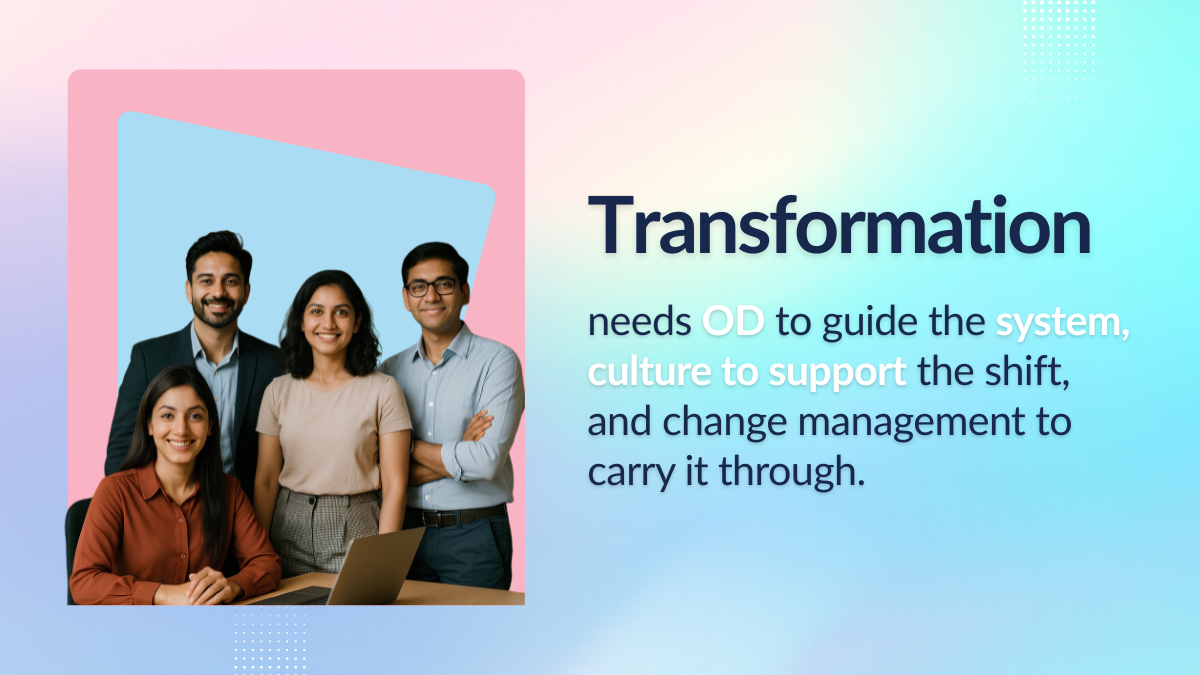
Business transformation often exposes cultural patterns that were invisible earlier.
For example, a company may discover that teams avoid difficult conversations. Or that leaders are aligned in meetings but not in execution. Or that employees do not trust new priorities because past initiatives were not followed through. These issues cannot be fixed only through process documents.
They require focused work on organizational culture, communication, leadership behavior, and systems of accountability.
Organizational development is a strategic approach that aligns strategy, structure, people, culture, and processes to support long-term growth and adaptability. (Orgvue) During transformation, this alignment becomes even more important because every gap becomes visible faster.
A strong OD leader helps companies ask practical questions:
· Are leaders saying the same thing across teams?
· Do people understand why the change is happening?
· Are managers equipped to handle resistance?
· Are incentives aligned with the new direction?
· Is the people strategy supporting the business strategy?
This is also where change management becomes more than communication. It becomes a structured way to help people move from old behaviors to new ways of working.
One of the biggest reasons companies hire fractional OD leaders is to create leadership alignment.
Transformation can become difficult when the senior team is not fully aligned on priorities, timelines, accountability, or trade-offs. Even small differences at the top can create confusion across the organization.
A fractional OD leader helps create common language, decision clarity, and leadership discipline. They can facilitate difficult conversations, identify hidden misalignment, and help leaders understand how their behavior affects the broader transformation.
This matters because employees often judge transformation not by what is announced, but by what leaders consistently do.
If leaders communicate one priority but reward another, the organization will follow the reward. If leaders ask teams to collaborate but continue to work in silos themselves, the culture will not shift. If leaders speak about accountability but avoid hard decisions, the transformation loses credibility.
Strong leadership alignment makes the change more believable.

Companies should consider hiring a Fractional Chief OD Officer when transformation is moving faster than theorganization’s internal capability.
This may include situations such as:
· A company is scaling rapidly and needs stronger structure.
· A founder-led business is professionalizing.
· A merger or acquisition is creating people and culture complexity.
· A new operating model is being introduced.
· Employee engagement is falling during change.
· Leadership teams are struggling to stay aligned.
· Internal HR is strong operationally but needs senior OD support.
In each of these situations, the goal is not only to manage change. The goal is to help the organization become stronger because of the change.
The success of business transformation depends on more than strategy. It depends on whether the organization can absorb, understand, and sustain change.
A fractional OD leader brings the experience to guide this process without adding unnecessary full-time overhead. They help companies connect transformation goals with people strategy, culture, leadership behavior, and execution discipline.
For organizations navigating growth, restructuring, digital transformation, or professionalization, fractional OD support can be a practical way to bring senior capability into the business at the right time.
With COHIIRE, companies can access experienced fractional leaders across critical functions, including OD, HR, technology, finance, marketing, and operations. For businesses going through transformation, this means access to senior expertise when decisions are too importantto leave unsupported.
.png)