
.png)

Businesses today are surrounded by data. Customer behavior, sales performance, operational efficiency, financial metrics, employee productivity and market movements can all be measured with greater precision than ever before.
Yet having more data does not automatically mean making better decisions.
For many organizations, the real challenge is turning information into clarity quickly enough for leaders to act on it. Reports exist, dashboards multiply and different teams often track different metrics, but the answers to important business questions can still take days or even weeks to emerge.
This is where Fractional Data Analytics Leaders can create considerable value.
Instead of building a large analytics leadership structure immediately or waiting months to recruit a permanent senior leader, businesses can bring in experienced analytics leadership for the period, scale and mandate they actually require. A Fractional Analytics Leader can help establish priorities, connect data with business objectives and create a decision-making system that continues to deliver value long after the initial engagement.
Most organizations already possess enormous amounts of information.
The bigger problem is fragmentation.
Sales may have one version of customer performance. Finance may look at another. Marketing tracks campaign effectiveness separately, while operations monitor its own dashboards. Each function may be producing perfectly valid numbers, but leadership is left trying to connect them.
The result is often more reporting, not necessarily more insight.
Effective Data-Driven Decision Making requires more than collecting information. It requires knowing which information matters, whether it can be trusted, how different metrics connect and, most importantly, what action the business should take as a result.
IBM describes data-driven decision making as using data and analysis, rather than relying primarily on intuition, to guide business choices. McKinsey's research has similarly highlighted that organizations can struggle with decision speed despite having access to increasingly sophisticated data and analytics.
That gap between having data and knowing what to do with it is fundamentally a leadership challenge.

A Fractional Analytics Leader operates at the intersection of business strategy, technology and decision-making.
The mandate is not simply to build dashboards or introduce another analytics platform. It is to understand what the organization is trying to achieve and determine how data can help leadership reach those goals faster.
Depending on the organization, this could involve improving customer segmentation, building more accurate demand forecasts, identifying revenue leakage, strengthening management reporting, creating predictive analytics capabilities or establishing a company-wide Data Analytics Strategy.
More importantly, experienced Fractional Data Analytics Leaders help businesses distinguish between what can be measured and what needs to be measured.
That distinction is critical.
When every metric receives equal attention, leadership teams can end up spending significant time analyzing information without becoming any closer toa decision. Strong analytics leadership creates focus by connecting metrics directly to commercial priorities.
Fractional Data Analytics Leadership gives organizations the ability to bring in experienced leadership against a clearly defined business mandate.
Instead of spending the first several months determining where to begin, an experienced leader can quickly assess the organization's existing data environment, identify gaps and establish priorities.
That can significantly shorten the distance between data and action.
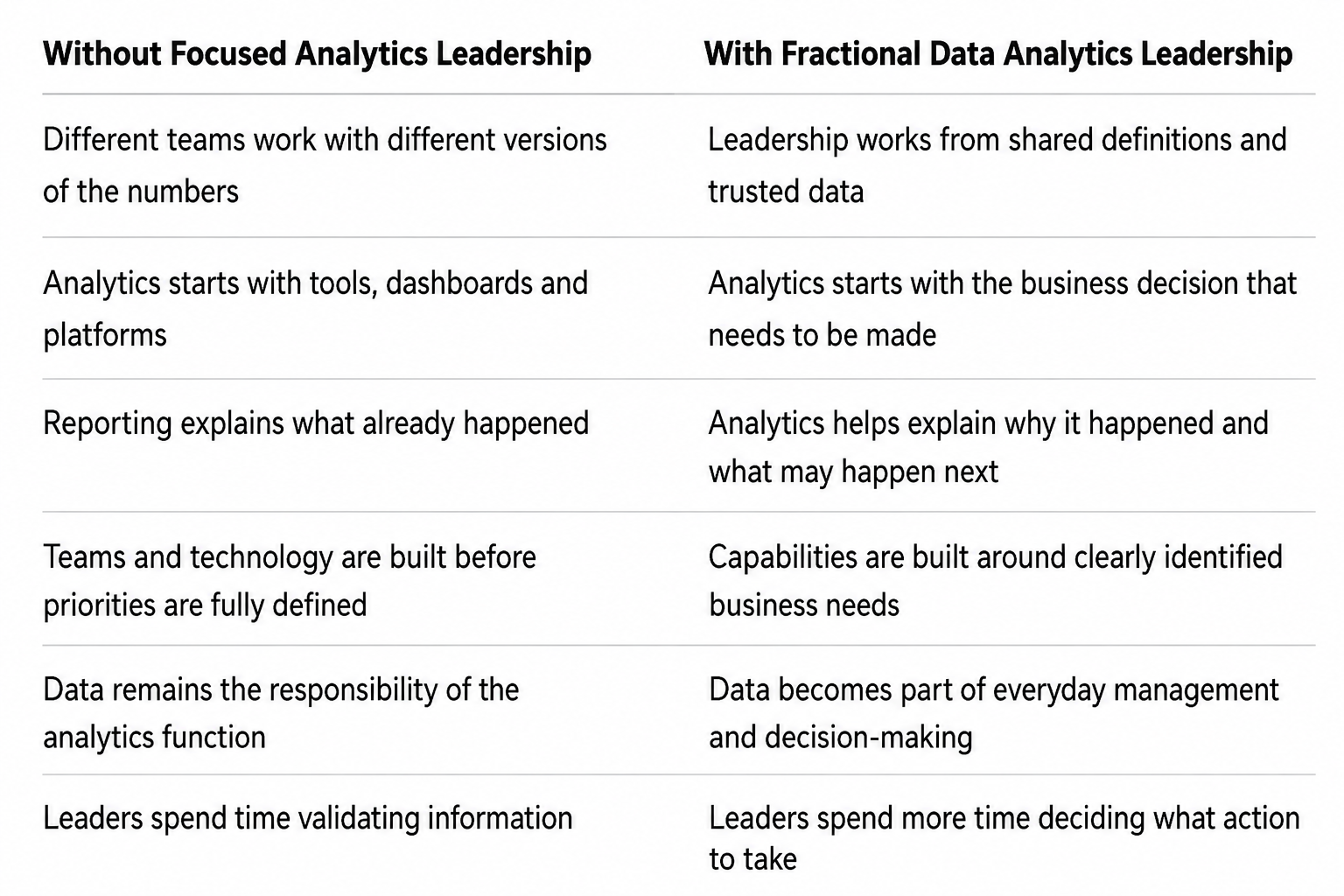
One of the biggest barriers to Faster Business Decisions is disagreement over the underlying information.
When sales, finance and operations are working with different data definitions, management conversations quickly become debates about whose numbers are correct.
A fractional data leader can help establish common definitions, reporting standards, ownership and governance.
The objective is not necessarily to create more reporting. It is to create greater confidence in the reporting that already exists.
When leaders trust the numbers in front of them, conversations can move from:
“Is this data accurate?”
to:
“What should we do about it?”
That shift alone can dramatically improve the quality of management discussions.
Analytics programs sometimes start with technology.
Which platform should we implement? Which dashboard should we build? Which AI capability should we introduce?
Experienced Fractional Data Analytics Leaders tend to begin somewhere else: with the business decision.
Which customers should we prioritize?
Where are margins deteriorating?
Which products are likely to see increased demand?
Where are we losing customers?
Which markets should receive additional investment?
What operational issue is creating unnecessary cost?
Once the questions are clear, the organization can determine what data and analytics are required to answer them.
This business-first approach prevents organizations from investing heavily in analytics capabilities that look sophisticated but have limited influence on actual decisions.
Many organizations are good at answering one question:
What happened?
Revenue increased. Customer churn rose. A geography missed its target. Inventory moved slowly.
Useful analytics leadership helps the organization progress towards more valuable questions:
Why did it happen?
What is likely to happen next?
What should we do now?
That evolution from descriptive reporting towards diagnostic and predictive analytics can fundamentally change decision-making.
Instead of discovering a problem after a quarterly review, leadership may identify warning signals while there is still time to intervene.
Recent developments around AI are making this increasingly important. As businesses introduce AI into planning and decision workflows, the quality, governance and usability of underlying data become even more critical. McKinsey has recently highlighted data readiness as a key requirement for organizations attempting to scale AI effectively.
A robust Data Analytics Strategy therefore becomes more than a reporting initiative. It becomes part of the organization's broader capability to compete.
Growing businesses often face a difficult question: how much analytics capability should they build, and when?
Hiring an entire senior analytics organization before the requirement is clearly defined can create unnecessary cost and complexity.
Waiting too long can be equally damaging.
Fractional Data Analytics Leadership offers another route.
A senior fractional leader can first establish the architecture, priorities, governance model and required capabilities. The organization can then determine which roles need to become permanent, which capabilities can remain external and what technology investments genuinely make sense.
This creates a more deliberate approach to capability building.
Rather than hiring first and defining the function later, the business defines the function and then builds the right team around it.
The ultimate goal of analytics leadership is not a better dashboard.
It is better management.
The strongest Data-Driven Decision-Making cultures do not treat analytics as something owned exclusively by data teams. Information becomes part of how leaders discuss performance, allocate resources, assess opportunities and manage risk.
A strong Fractional Analytics Leader can help embed this discipline across functions by establishing decision rhythms and improving the questions leadership teams ask.
Over time, the organization becomes less dependent on individual judgement and more capable of combining experience with evidence.
Importantly, this does not mean eliminating human judgement. Data rarely captures every nuance of a business situation.
The objective is to give judgement a stronger foundation.
There is no single trigger, but the requirement often becomes visible through recurring business problems.
Leadership may be spending too much time reconciling conflicting reports. Teams may have plenty of dashboards but limited actionable insight. Forecasting may consistently miss important changes. Customer information may sit across disconnected systems. Analytics investments may exist without clear commercial outcomes.
In other cases, the business may simply be growing faster than its current decision infrastructure.
These situations do not always require a large transformation program.
Sometimes they require experienced leadership capable of identifying what matters, creating the right structure and helping the organization move quickly.
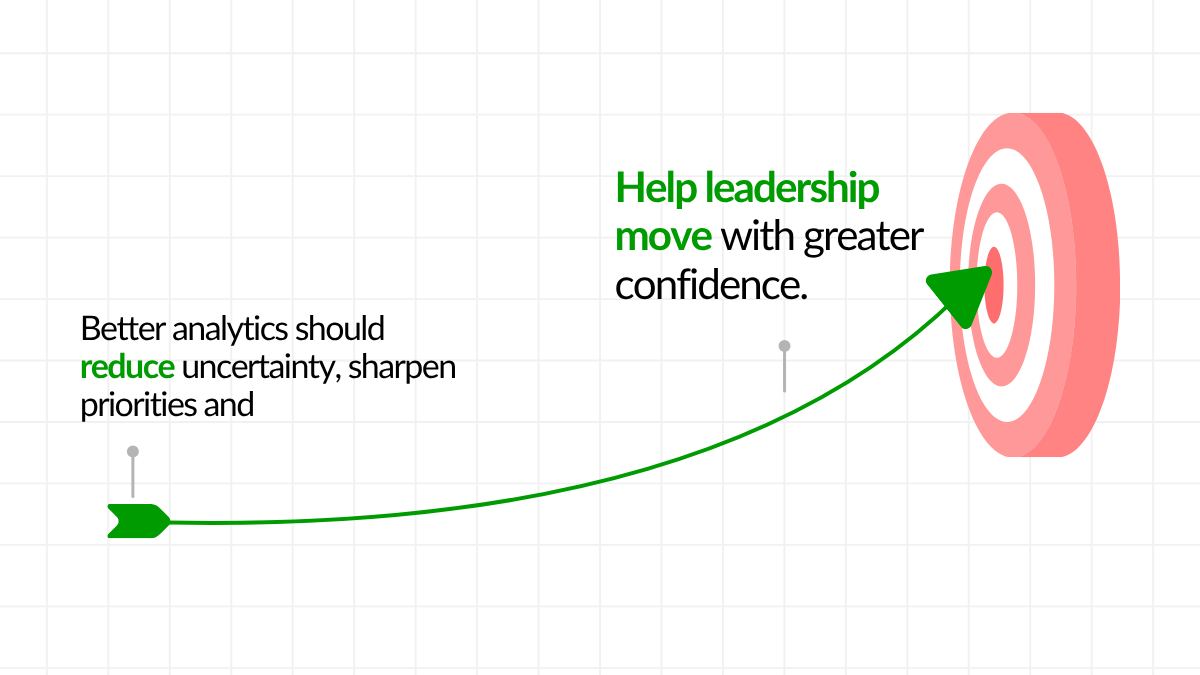
The competitive advantage today is increasingly not who possesses themost data.
It is who can understand it, trust it and act on it fastest.
That requires technology, certainly. But technology without leadership can simply produce more information for already overloaded decision-makers.
Fractional Data Analytics Leaders provide organizations with a way to access senior expertise precisely when the need arises. They can bring structure to fragmented data, align analytics with strategic priorities, improve governance, strengthen internal capabilities and establish a practical Data Analytics Strategy around the decisions that matter most.
The result is not simply better analytics.
It is Faster Business Decisions, greater organizational clarity and a stronger ability to respond when conditions change.
Looking to make faster, better-informed business decisions? Connect with COHIIRE to find the right Fractional Data Analytics Leader for your business.
.png)