.png)

.png)
Technology decisions are no longer confined to the IT department.
What a business builds, which platforms it invests in, how it uses AI, how securely it handles data and whether its technology can scale are increasingly business decisions. McKinsey notes that the role of technology leaders is moving beyond core technology into broader business and functional leadership.
But while the need for strong technology leadership is growing, not every organization needs that leadership in the same form.
For some businesses, hiring a full-time CTO is the obvious next step. For others, bringing in an experienced fractional CTO for a defined period or mandate may make far more sense.
The real question in the fractional CTO vs full-time CTO debate, therefore, is not which model is better. It is which model fits the business today.
The technology agenda facing businesses has expanded considerably.
Cloud infrastructure, cybersecurity, data, automation and AI increasingly sit alongside product development and IT operations. In PwC's 2025survey of technology executives, 40% ranked the rapid pace of technological innovation among their three biggest challenges to delivering technology strategy.
AI alone illustrates the pace of change. McKinsey's 2025 State of AI research found that 78% of respondents said their organizations were using AI in at least one business function, compared with 55% two years earlier.
As the technology agenda grows, businesses need someone capable of connecting technology choices to commercial priorities. What varies is whether that requirement warrants a permanent executive.
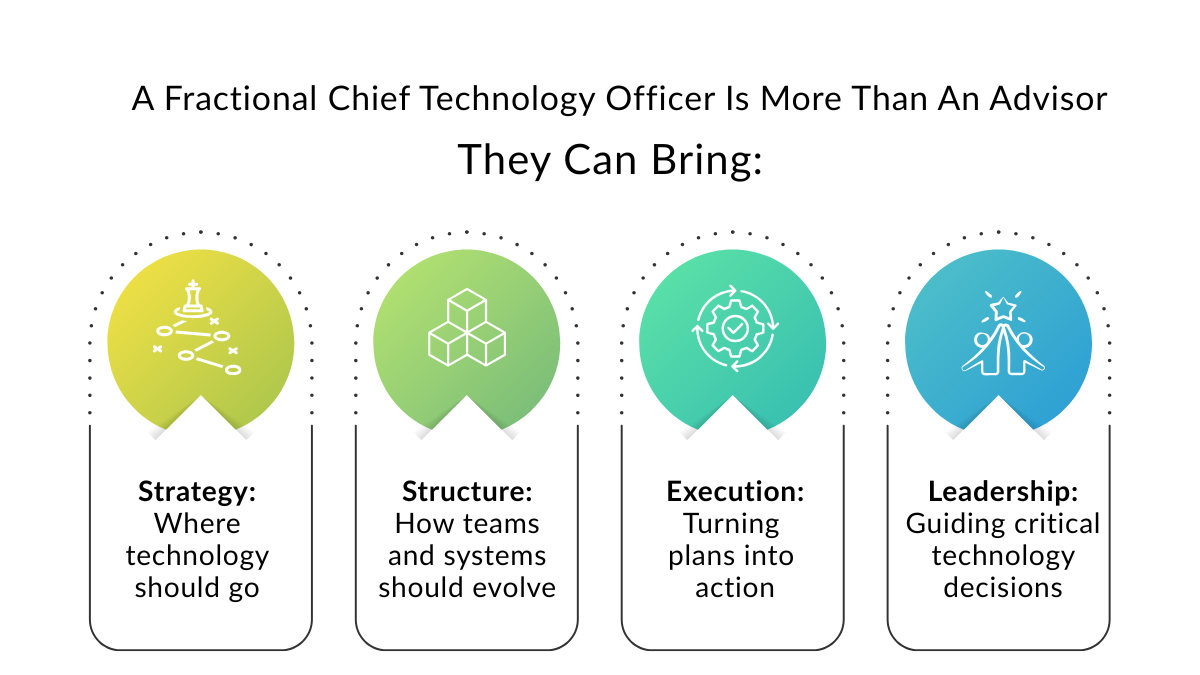
A fractional CTO is an experienced technology executive who works with an organization on a part-time or defined-engagement basis rather than joining as a permanent employee.
The scope can vary considerably. A fractional leader may be brought in to create a technology roadmap, assess architecture, guide an AI strategy, strengthen cybersecurity, support a digital transformation, advise the CEO or build the technology team that will eventually operate independently.
Importantly, fractional does not have to mean advisory-only. The strongest engagements combine strategic direction with accountability for implementation.
The model reflects a broader shift in how companies organize expertise. Deloitte's 2025 Human Capital Trends research found that 85% of executives believe organizations need more agile ways of organizing work to respond quickly to market change.
A fractional CTO can be particularly useful when the business has an important technology challenge but does not yet have a permanent C-suite-sized technology mandate.
Consider a growing company that needs to modernize its technology stack, choose between competing platforms, establish stronger engineering practices and develop an AI roadmap. These may be critical decisions, but once the foundations are established, they may not require a senior technology executive 5-6 days a week.
The model can also work well during transition: after a CTO departure,before a large transformation, during rapid scaling or while a company is determining what its future technology organization should look like.
In these situations, fractional leadership provides access to senior expertise without forcing the organization to design a permanent role before it fully understands what that role needs to become.
There comes a point when technology is too central, too complex or too continuous to be led fractionally.
A full-time CTO is usually more appropriate when technology is fundamental to the company's product or competitive advantage, when a large engineering organization requires daily leadership, or when major technology decisions need to be made continuously.
A permanent CTO can also build institutional knowledge over time. They participate in long-term planning, develop leadership teams, shape culture and remain accountable as technology decisions play out over several years.
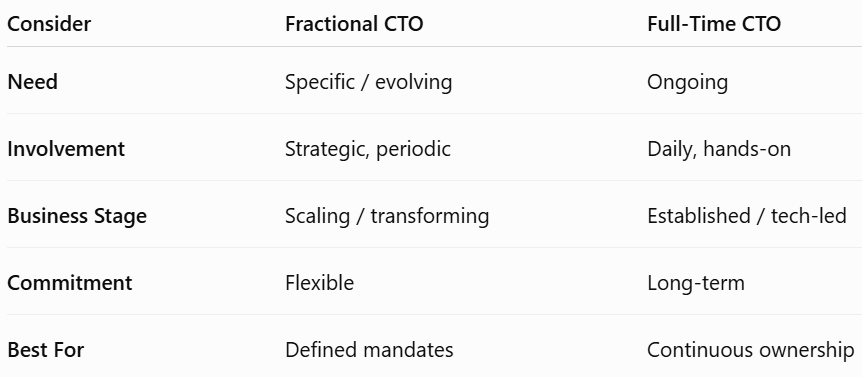
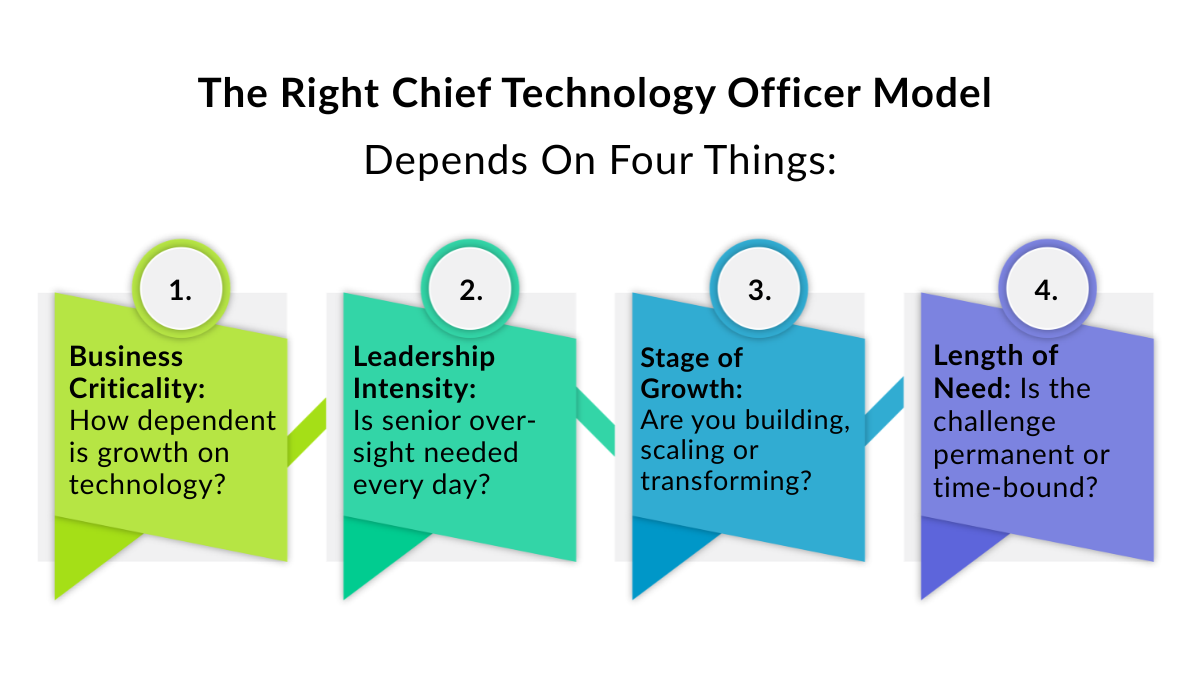
When evaluating fractional CTO vs full-time CTO, businesses should lookbeyond cost alone.
If technology is the product, permanent leadership often becomes essential. If technology primarily enables the business, a fractional model may provide sufficient strategic depth.
Building an engineering organization is continuous. Creating a technology roadmap, reviewing architecture or steering a transformation may be more defined.
Earlier-stage or rapidly transforming organizations may benefit from flexibility before committing to a permanent leadership structure.
If the leader needs to manage teams and make daily operating decisions, a full-time CTO may be the stronger choice. If the requirement is to provide direction, governance and senior decision-making at key moments, fractional leadership may work well.
Sometimes today's technology problem is not tomorrow's technology role.A fractional engagement can help an organizationunderstand what permanent technology leadership it will eventually require.
The fractional CTO vs full-time CTO decision ultimately reflects a broader change in how organizations think about senior leadership.
The traditional response to an important business problem was often to create a permanent position. Increasingly, companies can first ask a more precise question: What level of leadership does this problem require, and for how long?
Sometimes the answer will unquestionably be a full-time CTO. In other cases, a fractional CTO can bring the experience required to navigate a critical phase without creating a permanent role before the business needs one.
The objective is not to have more leadership. It is to have the right leadership at the right moment.
At COHIIRE, we help organizations access experienced fractional leaders for critical business mandates, including technology and transformation.