
.png)

.png)
As brands scale, marketing complexity often expands faster than internal alignment can keep pace. What once functioned effectively through founder instinct or agency-led execution begins to show strain as customer segments broaden, channels multiply, and competitive positioning becomes more deliberate.
In that environment, marketing activity increases and budgets become more defined, yet brand direction does not always evolve with the same discipline or cohesion.
This is where many growth-stage companies encounter familiar tensions. Agencies can accelerate execution, but they operate within defined briefs. When the brief itself lacks cohesion, adding more output rarely resolves the underlying issue.
The question then shifts from capability to ownership.
When should a business continue expanding agency partnerships, and when is it time to introduce dedicated marketing leadership with clear ownership? Engaging a fractional brand marketing leader is not simply an alternative resourcing decision. It is a structural choice about how brand direction, accountability, and long-term positioning are managed inside the organization.
For founder-led and PE-backed organizations navigating transition, this distinction reinforces the importance of brand leadership for growth-stage companies, particularly when positioning must mature alongside scale.
A fractional brand marketing leader is a senior marketing operator embedded within the organization through a structured fractional engagement, accountable for defining brand direction and ensuring that marketing activity aligns with commercial priorities.
The role extends beyond campaign oversight, introducing ownership of positioning, narrative consistency, and the strategic trade-offs that shape long-term brand equity.
Often engaged in the capacity of a fractional CMO or interim marketing executive, this leader operates within the decision-making framework of the business. They align marketing with revenue strategy, clarify channel priorities, establish disciplined measurement standards, and ensure that agency partners execute against a coherent mandate.
This model reflects a deliberate approach to marketing leadership on demand. It provides brand strategy leadership during periods of transition or scale, without prematurely committing to permanent C-suite.
The objective is not increased activity but structured clarity, consistent positioning, and accountable brand stewardship.
There are inflection moments when adding another agency will not solve the underlying issue.
A fractional brand marketing leader becomes relevant when:
· The founder is still the default brand decision-maker
· Agencies are working, but messaging lacks consistency
· Marketing performance fluctuates without clear diagnostic ownership
· Product, sales, and marketing are misaligned
· A rebrand or repositioning is required
· Investor pressure demands clearer brand differentiation
· The company is preparing for scale, fundraising, or category expansion
In these situations, the issue is not execution. It is leadership.
A seasoned fractional marketing executive brings senior judgment, commercial context, and internal accountability, which is something that external agencies are not structured to provide.
Within a fractional leadership mandate, the first 90 days are focused one stablishing clarity, alignment, and structural discipline before accelerating execution.
1. Brand Positioning Review: A structured assessment of current narrative, competitive differentiation, and message consistency across channels.
2. Customer and Market Validation: Re-evaluating the assumptions driving messaging, targeting, and channel allocation against commercial realities.
3. Leadership Alignment: Bringing founders, product, sales, and marketing into shared agreement on brand priorities and growth objectives.
4. Agency and Partner Realignment: Reviewing existing agency mandates to ensure they reflect strategic direction rather than historical momentum.
5. Measurement Framework Discipline: Shifting KPIs toward commercial outcomes, pipeline quality, and long-term brand equity.
6. Strategic Roadmap Development: Establishing a 6–12 month marketing direction that sequences initiatives against business stage and revenue priorities.
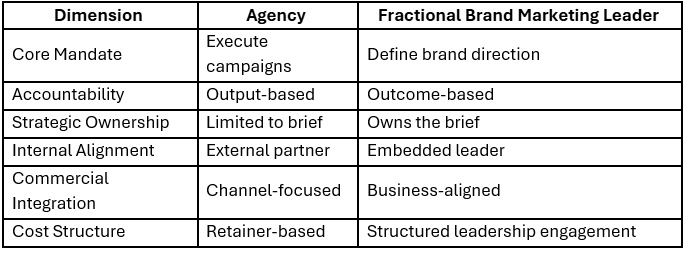
The decision between engaging an agency and appointing a fractional brand marketing leader is rarely a simple cost comparison. It reflects the maturity of internal marketing leadership and the degree of ownership required at that stage of growth.
Where senior marketing direction already exists within the organization, agencies can amplify execution effectively. Clear positioning, defined priorities, and established measurement standards allow external partners to operate with precision.
Where that leadership layer is absent, however, expanding agency engagement often increases activity without resolving fragmentation. Output grows, but alignment often does not.
In high-growth or transition-stage environments, a fractional CMO or interim marketing executive introduces calibrated oversight without imposing permanent structural overhead. This model of marketing leadership on demand aligns senior judgment with business volatility, enabling disciplined brand development while preserving capital flexibility.
Sustainable brand equity, particularly in high-velocity environments, depends on disciplined brand leadership, not simply expanded execution.
Explore how COHIIRE helps growth-stage organizations introduce fractional brand and marketing leadership with calibrated accountability and capital discipline.
· Fractional CMO vs. Marketing Agency: Which is better for your business?
· Fractional CMO vs Marketing Agency: What Moves for $3M–$50M Companies
· Fractional CMO vs. marketing agency: what’s the difference?
.png)