
.png)

.png)
For many growing companies, the need for senior HR leadership becomes clear before the business is ready to hire a full-time senior HR leader.
The founder starts seeing patterns.
Hiring takes longer than expected.
Managers are inconsistent in how they lead teams.
Compensation decisions become reactive.
Culture depends too much on individual personalities.
Performance conversations happen late, or not at all.
At this stage, the question is no longer whether the company needs HR. It does.
The real question is: what kind of HR leadership does the business need right now?
This is where the choice between a Fractional CHRO and a Full-Time CHRO becomes important.
Both models can add significant value. But they serve different stages, different business needs, and different levels of organizational complexity.
A Fractional CHRO is a senior HR leader who works with a company on a flexible or part-time basis. The role is strategic, not administrative.
The focus is usually on building the people systems required for growth. This can include organization design, leadership hiring, performance management, compensation structures, succession planning, culture alignment, HR processes, and manager capability.
For growing companies, this model can be especially useful because they often need experienced thinking, but not always a full-time senior HR cost.
A Fractional CHRO can step in to solve specific people challenges, build the right foundation, and guide founders or leadership teams through key decisions.
A Full-Time CHRO is a permanent member of the leadership team who owns the completeHR function on an ongoing basis.
This model works well when the organization has reached a certain level of scale and complexity. For example, the company may have multiple business units, a large workforce, complex employee relations, regional teams, leadership layers, and long-term talent development needs.
A Full-Time CHRO is deeply embedded in the business. They are responsible not only for designing the people strategy, but also for leading its execution consistently across the organization.
For larger companies, this level of continuous ownership can be essential.
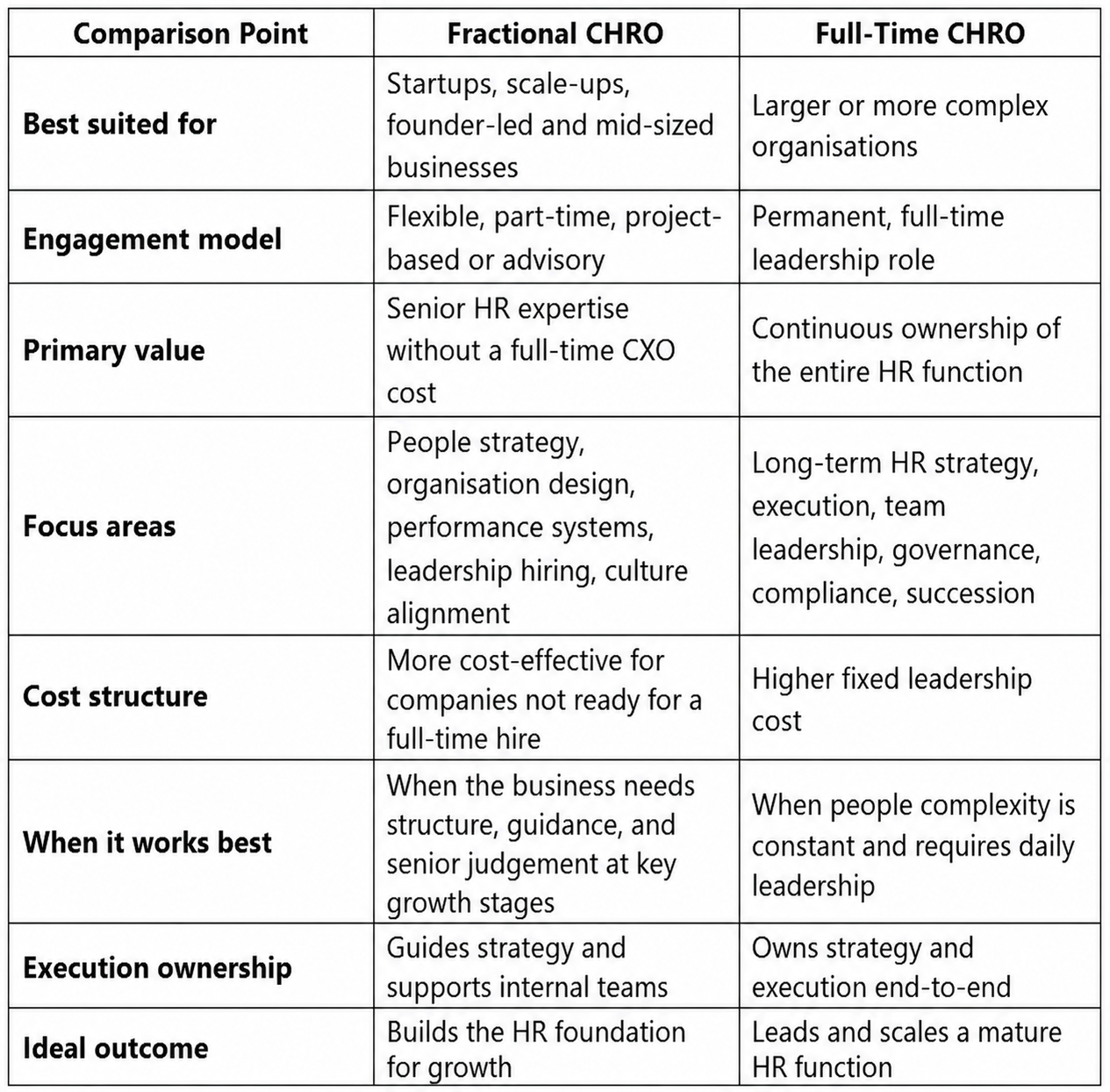
A Fractional CHRO often makes sense when the company is growing fast, but the HR function is still evolving.
This is common in founder-led businesses, startups, scale-ups, mid-sized companies, and family businesses going through professionalization.
At this stage, the company may not need a full-time senior HR leader every day. But it does need mature judgement at important moments.
For example, a Fractional CHRO can help when the company is:
· Scaling from founder-led hiring to structured leadership hiring
· Building performance and accountability systems
· Creating compensation and incentive frameworks
· Managing culture during rapid growth
· Preparing for expansion, funding, acquisition, or restructuring
· Strengthening manager capability
· Building HR processes before the business becomes too complex
In such cases, flexible HR leadership gives the company access to senior expertise without committing to a permanent CXO-level hire too early.

A Full-Time CHRO becomes more relevant when people complexity becomes constant.
If the organization has a large employee base, multiple locations, high hiring volumes, frequent leadership transitions, or a mature HR team that requires daily direction, a full-time leader may be the better option.
At this stage, HR is not just solving immediate gaps. It is actively shaping business continuity, culture, leadership depth, and long-term capability.
A Full-Time CHRO is also important when the company needs someone to be fully accountable for execution across every layer of the organization.
For example, if the business is managing thousands of employees, expanding internationally, dealing with complex compliance matters, or integrating multiple entities, full-time ownership becomes critical.
The real difference is not seniority. It is timing.
Many founders assume that the choice between a Fractional CHRO and a Full-Time CHRO is about the quality of leadership.
It is not.
Both can bring strong experience and strategic value.
The difference lies in timing, need, and intensity.
A Fractional CHRO is useful when the company needs senior direction, structure, and problem-solving, but not necessarily full-time involvement.
A Full-Time CHRO is useful when the business has reached a stage where people leadership must be embedded every day, across multiple decisions, teams, and systems.
For growing companies, making this distinction matters. Hiring a full-time senior leader too early can create unnecessary cost. Waiting too long to bring in senior HR thinking can create structural gaps that become expensive later.
Before deciding between the two models, leadership teams should aska few practical questions.
First, what is the current people challenge?
If the issue is specific, such as building performance systems, professionalizing HR, improving leadership hiring, or creating a scalable people strategy, a Fractional CHRO may be enough.
Second, how complex is the organization today?
If the business has multiple layers, large teams, serious employee relations issues, or constant people decisions, a Full-Time CHRO may be more suitable.
Third, does the company need design, execution, or both?
A Fractional CHRO can design strong frameworks and guide execution through the internal team. A Full-Time CHRO can own both strategy and daily implementation.
Fourth, what is the cost of delay?
Many companies wait until people problems become visible in attrition, poor hiring, unclear accountability, or leadership gaps. By then, the cost is already showing up in business performance.
The Fractional CHRO model is gaining relevance because growing companies need senior HR expertise without always committing to a full-time CXO hire.
Not every business is ready for a Full-Time CHRO immediately. But delaying strategic HR leadership can create gaps in hiring, performance, culture, structure, and leadership capability.
For many growing companies, a Fractional CHRO offers a practical middle path. It gives the business access to experienced HR leadership, stronger people systems, and strategic guidance at the right stage of growth.
The real question is not whether a Fractional CHRO is better than a Full-Time CHRO.
The better question is: what does the business need right now?
If the company needs direction, structure, and senior HR thinking without daily ownership, a Fractional CHRO can be a smart choice.
At COHIIRE, we help growing companies access experienced Fractional CHROs and senior HR leaders who can bring structure, clarity, and strategic people leadership at the right stage of growth.
.png)